Paradas
¿Cuántas paradas de carga necesita una ruta?
La potencia de carga pico es una cifra de marketing que se mantiene durante unos minutos. Lo que decide tu viaje es la potencia media en la ventana que realmente utilizas.
_--_2016_--_0275.jpg)
La curva de carga
Una batería no acepta energía a una tasa constante. La potencia es más alta a un bajo estado de carga y disminuye a medida que se llena el paquete, porque empujar corriente en una celda casi llena arriesga el plating de litio y daños permanentes. Los modelos de carga rápida a nivel de celda describen este comportamiento directamente [3].
Así que dos coches que publicitan la misma potencia pico pueden diferir en quince minutos en la misma parada, dependiendo de cuánto tiempo mantenga cada uno la potencia antes de disminuir. Un coche que alcanza un pico más bajo pero lo mantiene más plano a menudo es más rápido en la práctica.
Tasa de carga y estado de carga
Por qué 10-80%
Por debajo de aproximadamente el 10% corres el riesgo de llegar sin margen. Por encima de aproximadamente el 80%, la disminución es lo suficientemente pronunciada como para que estés esperando mucho tiempo por una pequeña cantidad de energía. Cargar del 80 al 100 puede tardar tanto como del 10 al 80.
Para un viaje largo, dos paradas del 10 al 80 casi siempre superan una parada del 10 al 100 más una segunda más corta. La excepción es el tramo final, donde cargar alto una vez tiene sentido porque no estás pagando la penalización de la disminución dos veces.
Las paradas son para ti también
La investigación sobre la fatiga del conductor apoya consistentemente descansos regulares en viajes largos, y el intervalo que surge está cerca de lo que un coche eléctrico moderno necesita de todos modos. La parada que resentirás como una restricción de carga es una parada que deberías estar tomando.
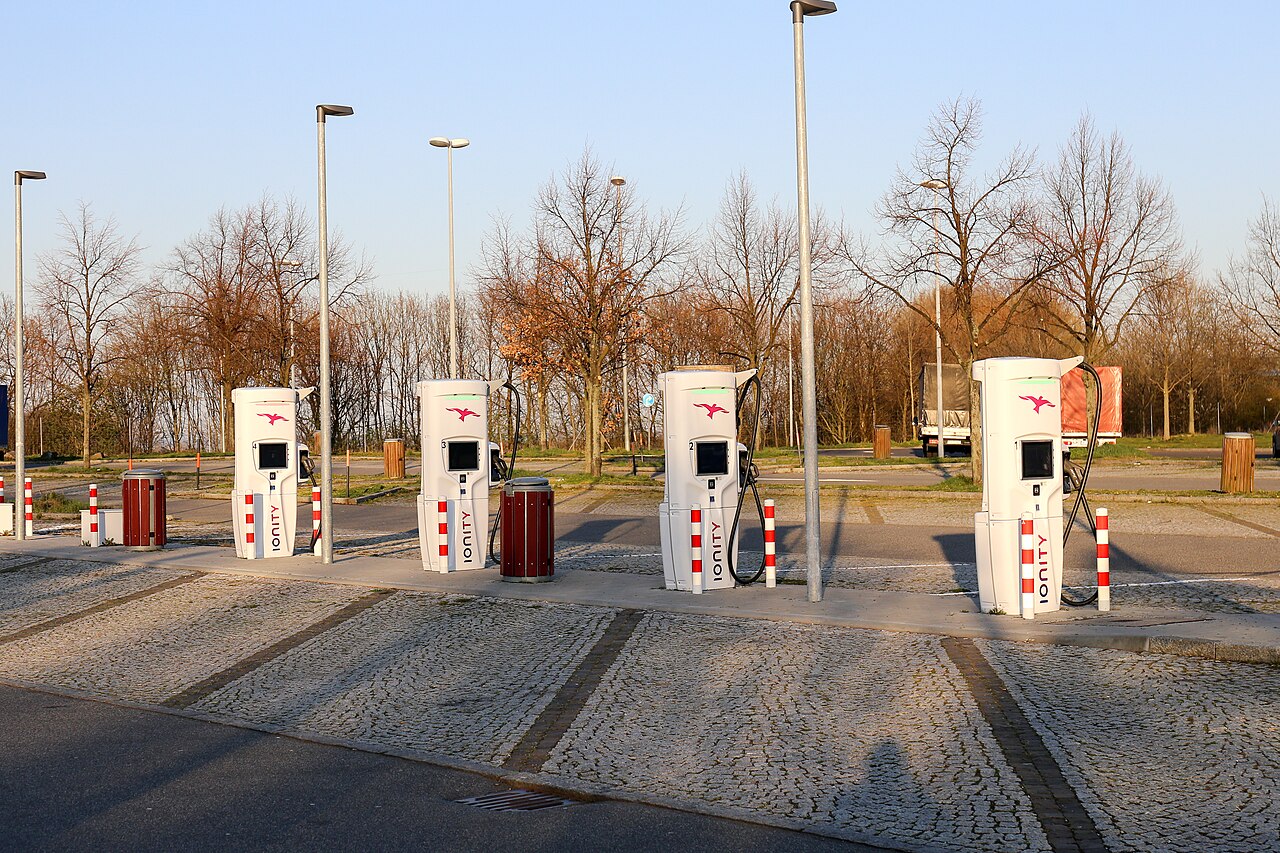
Lo que lo hace tolerable es dónde te detienes. Un cargador en un aparcamiento minorista sin iluminación y sin instalaciones es una experiencia diferente de uno adjunto a un lugar donde comer — que es el caso de nuestro sitio de comida en la autopista.
Preguntas frecuentes
¿Debo cargar al 100 % antes de salir?
¿Un coche con más kW de pico siempre carga más rápido?
¿Con qué frecuencia debería parar de todos modos?
¿Ayuda a la batería cargar solo hasta el 80 %?
_Dresdner_Tor.jpg)
Lectura relacionada
- ¿Cuántas horas deberías conducir realmente antes de hacer una pausa?
- Remolque o baca: ¿cuánta autonomía pierde un eléctrico?
Referencias
Cada cita a continuación enlaza con el registro original revisado por pares en PubMed o a través de DOI. Nada aquí sustituye el consejo médico.
-
Electric Vehicle (EV) Review: Bibliometric Analysis of Electric Vehicle Trend, Policy, Lithium-Ion Battery, Battery Management, Charging Infrastructure, Smart Charging, and Electric Vehicle-to-Everything (V2X) Veza I, Syaifuddin M, Idris M, et al. · Energies · 2024 · Journal article DOI
-
Dynamic Electric Vehicle Route Planning via Traffic Flow Prediction and Charging Service Integration Zhang Y, Shen X, Wang Y · Processes · 2026 · Journal article DOI
-
Dynamic User Equilibrium for Electric Vehicle Departure Time and Path–Charging Choices with Wireless and Fast Charging Services Zhang X, Ren H · World Electric Vehicle Journal · 2026 · Journal article DOI
-
Resilience-Oriented Predictive Energy Management and Route Adaptation for Long-Distance Electric Vehicles Under Charging Infrastructure and Road Network Uncertainties Khan B, Ullah Z, Gruosso G, et al. · World Electric Vehicle Journal · 2026 · Journal article DOI
-
Planning for Medium- and Heavy-Duty Electric Vehicle Charging Infrastructure in Distribution Networks to Support Long-Range Electric Trucks Then J, Agalgaonkar A, Muttaqi K · Energies · 2025 · Journal article DOI
-
Co-Optimization of Charging Strategies and Route Planning for Variable-Ambient-Temperature Long-Haul Electric Vehicles Based on an Electrochemical–Vehicle Dynamics Model Zhang L, Zhang M, Shan H, et al. · Sustainability · 2025 · Journal article DOI
-
Model Predictive Control Using an Artificial Neural Network for Fast-Charging Lithium-Ion Batteries Jaguemont J, Darwiche A, Bardé F · World Electric Vehicle Journal · 2025 · Journal article DOI
-
Fast-Charging Model of Lithium Polymer Cells Jaguemont J, Bardé F · World Electric Vehicle Journal · 2025 · Journal article DOI
-
Optimisation of Electric Vehicle Charging Stations Planning Based on Macro and Micro Perspectives WANG Q, DENG K, YAN J, et al. · Promet - Traffic&Transportation · 2025 · Journal article DOI
-
Personalised electric vehicle charging stop planning through online estimators Shafipour E, Stein S, Ahipasaoglu S · Autonomous Agents and Multi-Agent Systems · 2024 · Journal article DOI
-
Electric Vehicle Distribution Route Optimisation and Charging Strategy Considering Dynamic Loads Wu Q, Tian M · Polish Journal of Environmental Studies · 2024 · Journal article DOI
-
Multi-Objective Electric Vehicle Route and Charging Planning with Contraction Hierarchies Cuchý M, Vokřínek J, Jakob M · Proceedings of the International Conference on Automated Planning and Scheduling · 2024 · Journal article DOI
-
Electric Vehicle Health Monitoring with Electric Vehicle Range Prediction and Route Planning Jayaram J, Chetan J, Nayak B · Journal of Informatics and Web Engineering · 2024 · Journal article DOI
-
Comparison of EV Fast Charging Protocols and Impact of Sinusoidal Half-Wave Fast Charging Methods on Lithium-Ion Cells Althurthi S, Rajashekara K, Debnath T · World Electric Vehicle Journal · 2024 · Journal article DOI
-
An Implementation of Quasi-Newton Algorithm for Fast-charging Lithium-Ion Battery (LIB) Optimization in Electric Vehicle Application Anjarani M, Raharya N · International Journal of Electrical, Computer, and Biomedical Engineering · 2024 · Journal article DOI
-
End-to-End Direct-Current-Based Extreme Fast Electric Vehicle Charging Infrastructure Using Lithium-Ion Battery Storage Powar V, Singh R · Batteries · 2023 · Journal article DOI
-
Advancements in Electric Vehicle Charging Infrastructure: Fast Charging, Wireless Charging, and Smart Grid Integration Jordan Y. Arpilleda · International Journal of Advanced Research in Science, Communication and Technology · 2023 · Journal article DOI
-
Novel Hybrid Thermal Management System for High-Power Lithium-Ion Module for Electric Vehicles: Fast Charging Applications Karimi D, Behi H, Van Mierlo J, et al. · World Electric Vehicle Journal · 2022 · Journal article DOI
-
Optimization and Coordination of Electric Vehicle Charging Process for Long-Distance Trips Hassler J, Dimitrova Z, Petit M, et al. · Energies · 2021 · Journal article DOI
-
Simultaneous Long-Term Planning of Flexible Electric Vehicle Photovoltaic Charging Stations in Terms of Load Response and Technical and Economic Indicators Azimi Nasab M, Zand M, Padmanaban S, et al. · World Electric Vehicle Journal · 2021 · Journal article DOI
-
Optimization Approach for Long-Term Planning of Charging Infrastructure for Fixed-Route Transportation Systems Blat Belmonte B, Rinderknecht S · World Electric Vehicle Journal · 2021 · Journal article DOI
-
TEKNIK FAST CHARGING BATERAI LITHIUM-ION MENGGUNAKAN LOGIKA FUZZY Anshori A, Siswojo B, Hasanah R · Jurnal Ecotipe (Electronic, Control, Telecommunication, Information, and Power Engineering) · 2020 · Journal article DOI
-
The Design of DSP Electric Vehicle Charging Power Supply Jianning L · Vehicle Dynamics · 2017 · Journal article DOI
-
Bottlenecks to Fast Charging of Lithium-Ion-Insertion Cells for Electric Vehicles Chandrasekaran R · ECS Transactions · 2014 · Journal article DOI
-
Bottlenecks to Fast Charging of Lithium-Ion-Insertion Cells for Electric Vehicles Chandrasekaran R · ECS Meeting Abstracts · 2013 · Journal article DOI
-
Fast Charging Method Based on Estimation of Ion Concentrations using a Reduced Order of Electrochemical Thermal Model for Lithium Ion Polymer Battery Choe S, Li X, Xiao M · World Electric Vehicle Journal · 2013 · Journal article DOI